
- Exposing Fiduciary Breaches and Regulatory Failures

The Federal Court Petition to Vacate
Why a Federal Court Could Not Fix This.
On August 20, 2025, a petition was filed in the United States District Court for the Northern District of Illinois asking the court to vacate the FINRA award. Case No. 1:25-cv-09985. The petitioner is Terri P. Tepper, as Executor of the Estate of Lawrence Weiner.
On September 29, 2026, the court denied the petition and granted Oppenheimer’s motion to confirm the award of zero.
To understand how that happens on a record like this one, you have to understand what a federal court is — and is not — allowed to look at.
What a court is allowed to review
An arbitration award can be set aside only on the four narrow grounds listed in the Federal Arbitration Act, 9 U.S.C. § 10(a):
- the award was procured by corruption, fraud, or undue means;
- there was evident partiality or corruption in the arbitrator;
- the arbitrator was guilty of misconduct — including refusing to hear evidence pertinent and material to the controversy — or any other misbehavior that prejudiced a party’s rights; or
- the arbitrator exceeded his powers.
That is the whole list. Whether the arbitrator got the facts right, weighed the medical evidence correctly, or reached a fair result on fiduciary duty is not on it.
What “Very Limited” Means in Practice
You cannot ask the court whether the arbitrator got the facts wrong.
You cannot ask the court to weigh the medical testimony again.
You cannot ask the court to decide whether Oppenheimer breached its fiduciary duty.
The arbitrator did not have to explain the award — so there is no reasoning to challenge.
In the Supreme Court’s words, the question is “whether the arbitrator (even arguably) interpreted the parties’ contract.” Oxford Health Plans LLC v. Sutter, 569 U.S. 564, 569 (2013). Not whether he got it right.
Oppenheimer’s own client agreement warned of exactly this: “A PARTY’S ABILITY TO HAVE A COURT REVERSE OR MODIFY AN ARBITRATION AWARD IS VERY LIMITED.” (Ex. 8, ¶ 33(B))
What the family argued anyway
Within those limits, the Estate’s reply brief, filed in September 2026, made three arguments.
1. The arbitrator exceeded his powers — 9 U.S.C. § 10(a)(4). Oppenheimer told the arbitrator the case “comes down to one document, January 2021 signed by Mr. Weiner . . . . That is the hard stop.” (5/7/25 Tr. 202:22–203:1). That document is one sentence long, carries no effective date, and is dated by hand January 12, 2021 (Ex. 13). Oppenheimer’s own complaint department confirmed the higher fee was applied to the quarter beginning January 1 (Ex. 2). The brief’s argument: “No reading of an authorization signed January 12 reaches charges for January 1 through 11.”
2. The arbitrator refused to hear pertinent evidence — 9 U.S.C. § 10(a)(3). He reserved Oppenheimer’s non-production for “the May 7 hearing” (Ex. 4), and at the May 7 hearing told the family to “stick to the substance of the dispute.” (5/7/25 Tr. 119:9–14). The rules were enforced against the unrepresented family — their video excluded as “never produced,” live medical testimony required at their expense — and not against Oppenheimer.
3. Other misbehavior that prejudiced the family — 9 U.S.C. § 10(a)(3). Opposing counsel’s own written assessment, a week before the key conference, that the family had “alienated the Chairman.” (Ex. 10).
One Sentence. No Effective Date.
“You are authorized to update the fee on the above referenced OMEGA accounts from 1.25% to 1.95%.”
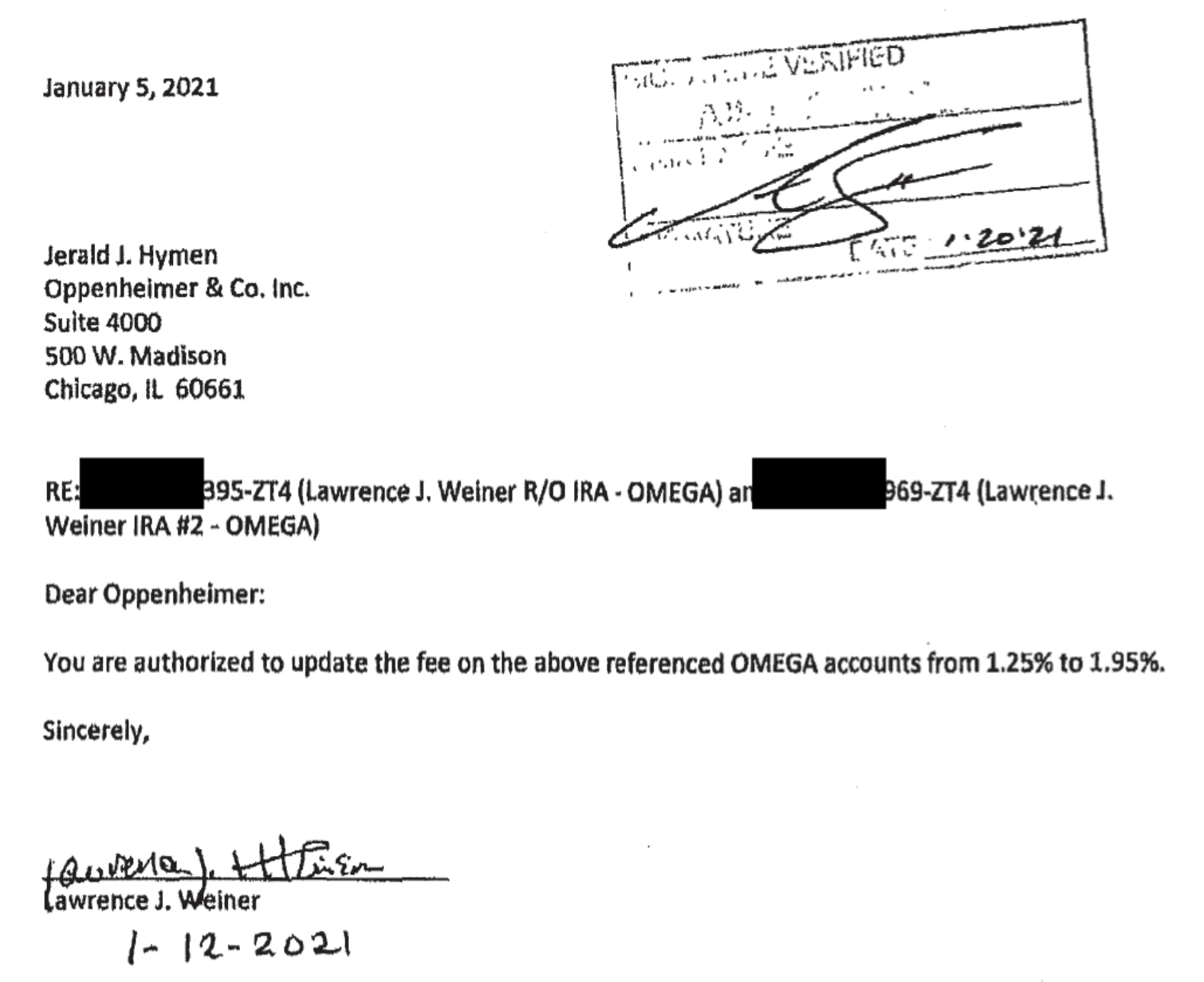
Typed date: January 5, 2021. Handwritten date: 1-12-2021. Oppenheimer’s signature-verification stamp: 1-20-21. (Ex. 13)
Fee charged at the higher rate: the full quarter beginning January 1, 2021. (Ex. 2)
The award left those charges in place without a word.
The result
On September 29, 2026, the court denied the motion to vacate and confirmed the award. Under the standard described above, even an award that leaves a pre-signature fee in place, issued after a hearing held without the fee records, survives review unless it fits one of the four narrow statutory grounds.
Why the family is not appealing
An appeal to the United States Court of Appeals for the Seventh Circuit would ask the same narrow question under the same limited standard. The merits — the fee, the medical evidence, the fiduciary duty — still could not be argued. It would cost the family tens of thousands of dollars in legal fees, with no ability to recover them.
The family has decided not to appeal, and to publish the record instead.
Every tribunal that touched this case was allowed to ask only whether the process was followed. None was allowed to ask whether an 80-year-old man with Parkinson’s disease should have been charged a higher fee before he signed for it.
The Documents
Each document below is a federal court exhibit, Case No. 1:25-cv-09985.
Petitioner’s Reply Brief — Introduction and Parts I–II (excerpt)
September 2026. OPCO-REPLY · pp. 1–11
Proves: the clearest statement of the arguments.
The Fee Letter
Typed Jan. 5, 2021; signed 1-12-2021. Ex. 13 · 1 p.
Proves: the only authorization: one sentence, no effective date, signed twelve days into the quarter.
The Patrick Wade Email
Apr. 18, 2024. Ex. 2 · 3 pp.
Proves: Oppenheimer’s complaint department, in writing: Q1 2021 fee “credited back” and re-charged at the higher rate from January 1 — before the January 12 signature.
Arbitrator’s Order — non-compliance reserved for May 7
Apr. 10, 2025. Ex. 4
Proves: non-compliance reserved for “the May 7 hearing.”
The McGuire Email
Apr. 21, 2025. Ex. 10 · 2 pp.
Proves: “Alienated the Chairman” and “costing your mother money” — Oppenheimer’s counsel, in writing.
Client Agreement ¶ 33
With Oppenheimer’s Amended Statement of Answer, Dec. 23, 2024. Ex. 8 · 16 pp.
Proves: the arbitration clause (¶ 33); “mid-2022”; “in person and in writing.”
Certified Transcript (complete) — May 7, 2025 hearing
May 7, 2025. Ex. 1 · 203 pp.
Proves: sworn testimony: the bonus, the denial, the medical witnesses, “stick to the substance,” “hard stop.”
Key passages
- 5/7/25 Tr. 119:9–14 — “stick to the substance of the dispute”
- 5/7/25 Tr. 202:22–203:1 — “That is the hard stop.”